

Why the sales rep is moving from the center of the funnel to the moments that matter most
In January 2025, I set out to build a hunting organization with two objectives: reengage accounts that had been dormant for more than two years and win net-new customers.
The assignment felt familiar. During a 35-year career in sales leadership, I had built teams, helped startups move from zero to first revenue, and created new paths to market. But this time, one part of the equation had changed dramatically: buyers no longer needed a sales representative to begin the buying process.
Since the introduction of the structured sales process by NCR in 1887, new technology changed how quickly buyers and sellers could connect, but not the basic relationship between them. Ships, railroads, automobiles airplanes, telephones and computers expanded the speed and reach of commerce. Yet the Sales Rep remained the gateway to product information, pricing and access.
The tools changed but the seller stayed at the center
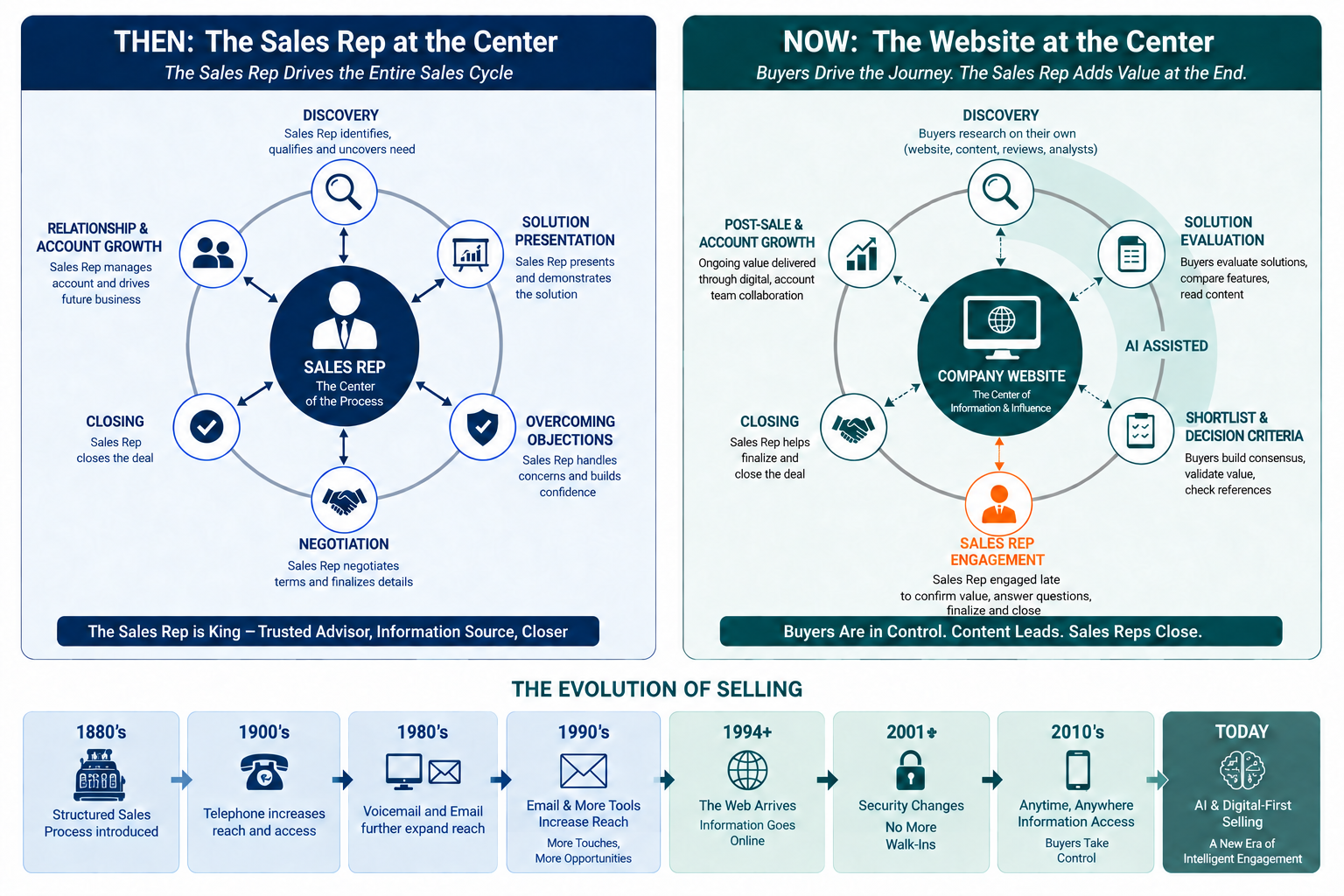
The center of the buying process has shifted to the company website, while AI now assists the early stages and human sellers add value at critical moments.
That model began to break with the arrival of the commercial web. Netscape Navigator helped make the internet accessible to a mass audience in 1994. At first, corporate websites were little more than digital brochures. Over time, companies added product briefs, specifications, comparisons, pricing guidance, customer stories and technical content.
Then smartphones put that information in every buyer’s pocket. Prospects could research products whenever they wanted, compare alternatives and form opinions—sometimes informed, sometimes incomplete—before speaking with a seller.
The sales rep did not disappear. But the rep was no longer the keeper of basic product knowledge. The website, search engines, peer communities and, increasingly, AI became the buyer’s first stop.
Buyers want independence and help at critical moments
Many companies still operate as if a weak website can be rescued later by the sales team. That assumption is becoming more expensive. In March 2026, Gartner reported that 67% of B2B buyers prefer a rep-free experience, and 45% had used AI during a recent purchase. Buyers are clearly becoming more self-directed and digitally enabled.
That does not mean buyers no longer value people. A second Gartner study published in May 2026 found that 69% of B2B buyers turn to sales reps to validate AI-generated insights. Buyers want independence during research, but they still seek human judgment when they need context, reassurance or help navigating a consequential decision. This explains why you might be seeing promising email open rates and intent scores yet the prospect doesn’t respond to your connection attempts. They simply aren’t ready for you yet and you need to be OK with returning them to nurture and move on to someone who truly needs your help.
This is not the end of human selling. It is a relocation of human selling—from the center of every activity to the high-value moments where expertise and trust matter most.
How I would build the model today
If I knew in 2025 what I know now—and if today’s agentic AI capabilities had been available—I would have recommended a different operating model: begin with fewer reps; use AI agents to monitor and qualify a larger universe of potential buyers; and add human capacity as the volume of qualified opportunities grows.
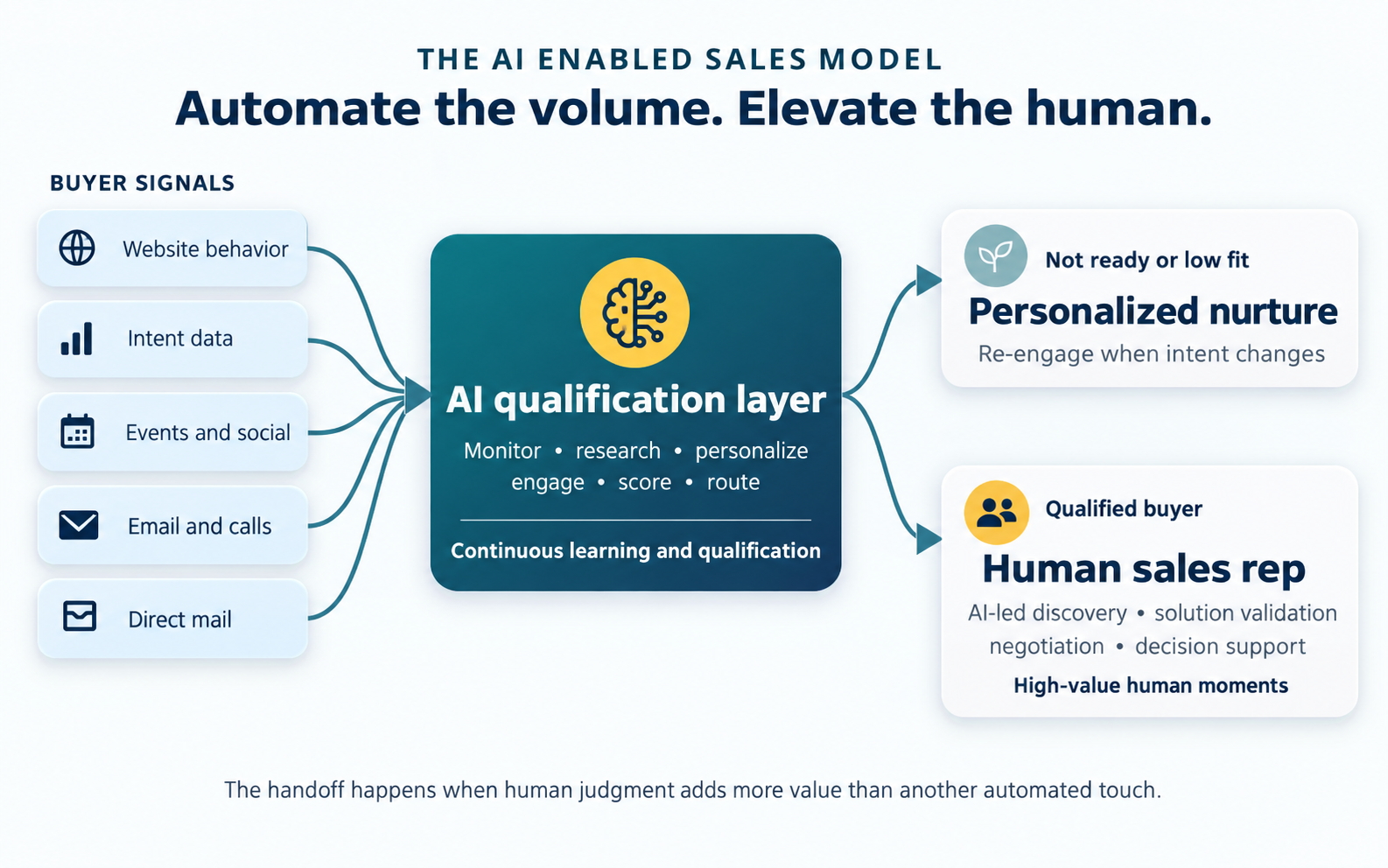
An AI qualification layer absorbs volume, nurtures buyers who are not ready and routes qualified buyers to human sellers for solution validation, negotiation and decision support.
The opportunity ahead
AI Sales Agents are here, and there is no reason to fear them. Organizations that embrace and use them to improve the buyer and seller experience stand to benefit greatly from the biggest shift in selling since the introduction of Netscape Navigator in 1994. The winners will not be the companies that replace the most salespeople with AI. They will be the companies that redesign the work: machines handling persistence, pattern recognition and scale; people handling ambiguity, trust and decisions.
Three actions sales leaders can take now
1). Make your website your best first sales conversation
Your digital experience must explain why your company exists, which business problems you solve, how your approach is different and what a buyer should do next. If your content cannot answer a serious buyer’s first questions, fix it before spending more on outbound activity.
2). Move reps toward higher-value work
AI agents are not a substitute for every human interaction. They make it possible to reserve sellers for the moments that require business judgment, solution validation, negotiation and consensus building. That raises the bar for product knowledge, industry fluency and consultative skill.
3). Use AI as a qualification layer—not a spam cannon
AI can monitor intent, research accounts, personalize outreach, maintain cadence, score engagement and nurture buyers at a scale no individual rep can match. But volume alone is not the goal. Governance, relevance and brand protection matter. The objective is to identify genuine buying signals and create a timely, informed handoff to a human seller.
In Part 2, I will evaluate the leading AI sales agents and assess how ready they are to manage outbound campaigns, qualify demand and create a clean handoff to a human seller. Subscribe to Massbridges Insights to receive the next article.
About the Author
Marc Bridge is an enterprise technology sales executive and go-to-market builder with more than 35 years of experience creating, rebuilding and scaling sales organizations. His career spans startups, high-growth companies and global enterprises across cybersecurity, cloud, SaaS, networking and infrastructure. Through Massbridges, Marc explores how AI is reshaping B2B buying and selling and translates emerging technology into practical strategies for growth.
Excellent today-as-history view of the AI moment and place in the sales cycle, and where the human sales component works best right now! Thank you, Marc!
Thanks for the comments Jim, knowing how much you are already using AI in your business to extend your reach and capabilities just imagine what the world is going to look like in another 20 years with 7x24x365 AI agents serving us. There is no end to what human ingenuity can achieve!